Here now and now here or nowhere

The title of this blog comes from a play on words that "now here" is also the same letters as "nowhere" just with a space added in the middle. I am always trying to get better at being in the here and now, and I've always been a bit of a joker so that is why I chose this name.

Sunday, October 10, 2010

Guangzhou eating is where it's at...

Guangzhou is a hot, humid, sticky, and relatively boring city. So why should one go there? (I was wondering this myself) DIM SUM!! Guangzhou is the capital of Guangdong province, known to the older US generations as Canton. When you break it down you realize Cantonese food (what most of the US chinese food is) is from here. Dim Sum reigns supreme and you can eat it nearly 24 hours a day, if you know where to go. And it's not crappy, lame dim sum by any means, this stuff is good. I mean great. I want to be friends with it, it's that good. Besides the food though, I can't recommend too much. There is a small town about 1.5 hours away that has two beautiful old temples on a river (blog to follow shortly on that) and GZ has some nice museums but mostly the city was quite lame. That said, still go. Go for the food! (little note. If you go to the right market and can speak the language you can buy ANYTHING to eat. Dog, cat, monkey... you name it. And no I am not joking. I actually sort of wanted to eat monkey, but more so to score up on a sort of joke with my fellow blogger Aaron Weintraub at fatherfolk.com)

and now the food pics

Dim Sum!! Dumplings, radish cake (one of my favorite dishes) chestnut cake (ehh...) and the Guangzhou special wide rice noodle dish. You can get this in the states but it usually is much smaller in three noodles and only has one thing inside (shrimp, pork, beef and mushroom are the usual suspects). This one had a variety of things inside and was very tasty.
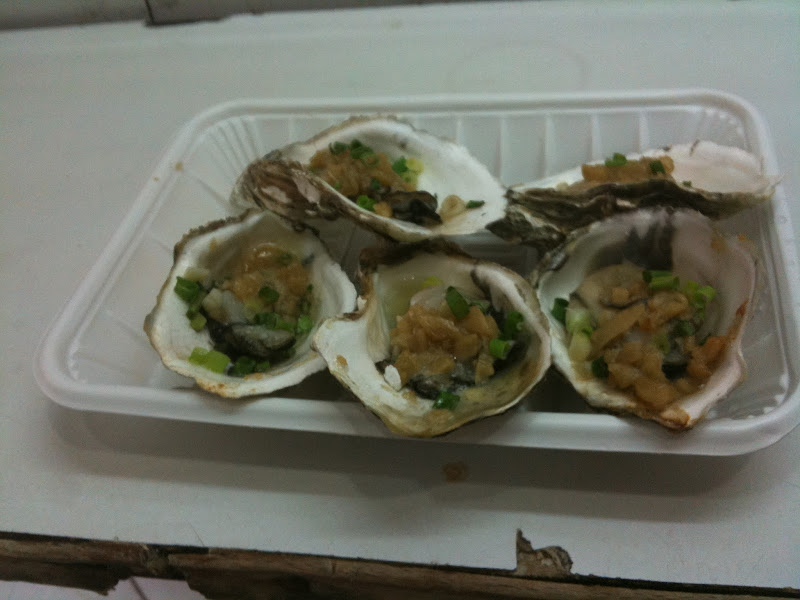
BBQ'd garlic oysters. yum!

We went out for dim sum to a well known dim sum spot, but the restaurant was no longer serving at the time we went so we ordered some dishes instead. in the back left is a green bean and eel dish that was very good. The yellow rice was a guangzhou style fried rice. In front on the small dish was duck tongue. The big dish in front was lotus root and chestnuts. And the left front dish was pigeon. We also had a very good spicy fish head dish but it wasn't shown here.

The pigeon a little closer. It was cooked in a peking duck style and being that I don't love peking duck, I wasn't so much of a fan of this.

Some little girls stopped me on the street to ask me questions in english. Their orange cards in their hands have both english and chinese questions on it. They really had fun with me, or maybe I really had fun with them.

Went to a museum and checked out "Environment Chromatic Interferences" by Carols Cruz-Diez. It was a very interactive exhibit and I rather enjoyed it.

With my oncoming fever I had a slight headache so looking at pictures like this really hurt. The picture would somewhat change colors depending on your angle of viewing.

Guangzhou was founded by 5 gods who rode goats into the city. That is why there is a goat in this picture.

The museums sculpture garden.

So, I had a fever and how do you treat a fever in china? By eating healthy of course!!! A ginger broccoli dish, that I could have eaten for days. Congee in the middle. Seaweed and squidball soup in the back right and then my drink of lemon, ginger, sugar, and hot water. I do have to say, afterwards my body started to feel a bit better and the next morning I was nearly 100% healthy.


Sunday, October 3, 2010

Time in Shantou

I stopped in Shantou on the way from Xiamen to Guangzhou for one reason, I heard the food was great. The rumors were indeed true. We're in Canton country, where delicious dim sum comes from. I met up with Kian, a super friendly and great couchsurfer who really put me up to an amazing level. As soon as I got in he and a friend picked me up and we went to dinner at a nice restaurant that specializes in the local cuisine. Then we went to a bar to meet some of his friends. It was me and like 8 people, 3 of whom could speak good english but all were going off in the local dialect. It didn't matter as I was having a great time, even learned a fun chinese drinking game called 0,5,15,20 (which i did pretty well in, if i may so so myself). The next day we went to the beach at sunset and did some swimming and bodyboarding in the ocean. It felt so great to be back in the water. I can't wait to get to Hainan now to do some real surf. After the ocean we grabbed some hot pot and then went to an old (maybe the oldest in the town) little shop for a local fruit jelly ice type dessert. The following morning Kian took me for dim sum brunch and seriously, it was some of the best I've ever had.

Shantou is a small city and a bit humid but the local people are incredibly friendly and I highly recommend it for anyone traveling down the coast of china. The food, people, and culture will not let you down.

Ducks liver, ducks meat, and ducks wing. Shantou specialties.

Various local dishes served up right!

A dessert speciality of Shantou, fruits, nuts, and jellies mixed into a sugar/water/ice mix. incredibly tasty and refreshing on a hot humid night.

Kian tasting one of the local special fishballs while at dim sum. Honestly, this may have been the most tastiest dim sum I've ever had. Can't wait to see how HK compares.


In case you ever want to buy dried starfish or a really big dried fish, the rest stop between Shantou and Guangzhou is the place to do this. :)


Friday, October 1, 2010

Hakka Tulou, Fujian Earth Buildings

So my main reason of going to Xiamen was to see the Hakka Tulou buildings, the Kinmen visa run was a side benefit of being down there. So, what are the Hakka Tulou? Well, wikipedia describes it best.

"A tulou is usually a large, enclosed and fortified earth building, rectangular or circular in configuration, with very thick load-bearing rammed earth walls between three and five stories high and housing up to 80 families. Smaller interior buildings are often enclosed by these huge peripheral walls which can contain halls, storehouses, wells and living areas, the whole structure resembling a small fortified city. The fortified outer structures are formed by compacting earth, mixed with stone, bamboo, wood and other readily-available materials, to form walls up to 6 feet (1.8 m) thick. Branches, strips of wood and bamboo chips are often laid in the wall as additional reinforcement. The end result is a well-lit, well-ventilated, windproof and earthquake-proof building that is warm in winter and cool in summer. Tulous usually have only one main gate, guarded by 4–5-inch-thick (100–130 mm) wooden doors reinforced with an outer shell of iron plate. The top level of these earth buildings has gun holes for defensive purposes." (http://en.wikipedia.org/wiki/Fujian_Tulou)

So, that's the technical description, lets see some pics, shall we?

On the way to the Tulou we passed many many fields of bananas growing. Freaking awesome! We even stopped and bought some fresh tropical bananas, nothing like a fresh picked ripe banana.


mountains, trees, rivers. so much natural beauty.

The first sign of earth buildings. though not as spectacular as the main tulou, these buildings still are quite a marvel when you think of how they are built and how old they are.

A circular Tulou

drive by bus window shot

The famous Tianluokeng tulou cluster (http://en.wikipedia.org/wiki/Tianluokeng_tulou_cluster) shot from above.

me in front of the Tianluokeng tulou cluster

Tianluokeng Tulou cluster from below.

Old Tulou building.

The chinese seemed to really like this building. I have no idea what it was but why not grab a photo.

Tulou, and a pretty stream running by it.

Ducks!. look at this racial harmony, black and white happy together. if only humans could take lesson from this.

Entering Yuchanglou, prepare yourself for what you're about to see.

Yuchanglou! It is one of the oldest and tallest tulou in China. Yuchanglou has been nicknamed the "zigzag building", because the vertical wooden post structure is not straight and perpendicular, but zigzags left and right. It was built that way due to an error measuring the building materials. But in spite of this apparent infirmity, this tall tulou withstood 700 hundred years of natural elements and social turmoil. Yuchanglou's outer ring is 36 m in diameter and boasts five stories, with 50 rooms on each floor.Each of the 25 kitchens on the ground floor at the back half of the circle has a private water well beside its stove. This is the only tulou in all Fujian with such convenient water supply

looking up from fresh inside the door.

from the bottom, up.

A stairway up. there were various stairs leading to different sections of the Tulou. Not meant for tourists to climb, I played "ignorant American" and climbed the whole way up. "whoops, I didn't know we weren't supposed to :P"

From the third floor

a view of the stairs going up.

looking out a window, also meant for a gunnery hole.

view from the top.

view from the top looking into the center building structure. Believe this was also used for a temple.

me and one of the residents, posing for pictures.

Yuchanglou from outside.

lady doing laundry in the river.

inside a smaller tulou.

wouldn't you love living here. how peaceful and serene, minus all the tourists walking around your neighborhood.

rectangular tulou.

bananas ripening.

A few feet away from the bus stop was this lush wildlife. I wanted to just follow the trail forever. Living off bananas and insects.


Outside Chengqilou. Nicknamed "the king of tulou", of Gaobei Tulou cluster at Gaotou village of Yongding County was built in 1709. Inscribed as UNESCO World Heritage Site 1113-003 in 2008. It is massive rotunda tulou with four concentric rings surrounding an ancestral hall at the center, the outer ring is 62.6 meters in diameter and four storeys tall, 288 rooms, with 72 rooms on each level, circular corridor on 2nd to 4th floor, with four sets of staircases at cardinal points connecting ground to top floors. A big roof extending out ward covers the main ring. The ground floor rooms are kitchens for family branches, the second level rooms are grain storage rooms, and the 3rd and 4th floor rooms are living quarters and bedrooms. The second ring of 80 rooms is two storeys high, with 40 rooms on each level, the third ring served as community library, one storey with 32 rooms; there are 370 rooms in all. The 4th ring is a circular covered corridor surrounding the ancestral hall. If a person stayed for one night in each room, it would take him more than a year to go through all the rooms. The ancestral hall is at the center. Chengqilou has two main gates and two side gates. 15th generation Jiang clan with 57 families and 300 people live here. At its heyday, there were more than 80 family branches lived in Chengqilou.

Chengqilou from a different angle. I didn't know how famous it was, otherwise I would have totally gone in and peeked around. I was on a tour bus where no one spoke english AT ALL! so when we got here I didn't know what they were saying and it cost to go in so I figured, fuck it. Wish I had gone in now after doing some research. Oh well.


Fuzhou to Xiamen

I woke up in the Super 8 hotel room and finished packing my bags. I was to go to Xiamen today in hopes of getting to the Kinmen islands. I needed to go there because my visa is only valid for 30 days at a time in China and this island chain belongs to Taiwan. I didn't have a train ticket or a boat ticket and this is the busy travel time, as its the mid-autumn festival and people have work off. When I checked out of the hotel, the skies were grey and the rain was around me but light. I hailed a taxi and translated somehow that I needed to go to the high speed train station. The train to Xiamen costs roughly the same as the bus but takes half as long and is more comfortable, a no brainer really. Seated in the passengers seat I could see and hear the rain getting heavier. Within a few minutes we were hydroplaning all over the place and visibility was near non-existent. I wasn't worried about the train not running but the boat worried me. A thought of rocking all over the place or worse, cancelled. Of course I would still need tickets for both train and boat and there was no guarantee. Usually when I try to buy a ticket the day of, I can't and I get stuck for a day at the place. But once I got out of that cab at the rail station, everything started to look up. The ticket window queue was massive, but the electronic one was near empty. The next train was available. When I got to Xiamen I got a cab quickly and he took me to the international ferry. The next ferry was leaving in 30 min and had room available. I grabbed a cup of coffee there and it was delicious. Also, I could exchange Chinese yuan for Taiwan dollars at the ticket counter for barely any exchange fee. The sky wasn't very sunny but it wasn't raining either. The sour day had now become semisweet.

At the ferry terminal I ended up chatting it up with the only other white guy there, a fellow from Belgium. He too needed to do a quick visa run only he just went over and came straight back, no over night.

My Belgium friend sleeping on the way over to Kinmen


The very intimidating drug dog at Kinmen's International ferry.


I had a few hours in town before meeting up with Hao Fu, my host for the night. So I did what I do in any town when I get to it, I ate some local food.

a noodle and meat soup and some sides of marinated eggs, tofus, and meats.


When I met up with Hao Fu, she wanted to get dinner. Having only eaten an hour and a half ago I wasn't too hungry, but who was I to say no. So we got some different type of noodle dishes. I went with a wonton style and a side of porks blood soup.

Dinner of champions. Pretty tasty and cost in total under $1.50. not bad indeed

After dinner we went to her parents place to spend the rest of the evening. Her mom, a huge baseball fan, was watching the local Taiwan team play on TV. Her dad was just coming in from the day of work. We sat around and sort of talked. I say sort of as Hao Fu was the only one who spoke both languages :) But we all seemed to enjoy ourselves and pretty early we headed to bed, something I was for sure ok with after my numerous hour in numerous ways travel days.

Hao Fu's dad offering me some Kaoliang, Taiwans local alcohol. Made from sorghum, it is a major product of the Kinmen Islands. You can see fields and fields of sorghum when you drive around Kinmen. Not really my cup of tea, but I'm glad I got to try it.

In the morning I woke up with the roosters. Hao Fu's parents have a small sort of farm. It seemed like most of the neighbors did.

Hao Fu's dad's animal pen. chickens and geese here.

The neighbors cow. I loved coming outside in the morning and this is the first thing that I saw. :)

the female goats, ready for some breakfast grub of grains and soy mush.

the poppa goat. this guy was gruff indeed. though he had a nice life of just him and numerous ladies upstairs.


After feeding the animals Hao Fu drove me to the bus stop and she headed off to work. I had some time to kill before the bus so I wandered the city center a bit and then got on the bus to the ferry and then back to Xiamen, China.

I came across a small temple of sorts. Notice how colorful the Taiwanese temples are. The dragons in the roof corners are so much more vibrant.